In Short: For those interested in understanding crime in specific areas, tools like crime data pin maps can offer valuable insights. Visit gofyapp.com to explore interactive crime maps and get detailed information on crime trends in your city.
The psychology behind criminal behavior examines how thinking patterns, emotions, development, relationships, and circumstances can contribute to unlawful actions. It looks at interacting influences rather than a single “criminal personality.” Understanding those influences helps explain risk, guide prevention, and distinguish evidence-based analysis from speculation about individual cases. (ojjdp.ojp.gov)
What Does the Psychology of Criminal Behavior Explain?
The psychology of criminal behavior explains psychological processes that may contribute to offending, including how people interpret situations, justify harmful choices, respond to pressure, and weigh consequences. It also examines change: which beliefs, skills, and relationships might help someone stop offending. The focus is not simply on identifying what is “wrong” with a person, but on understanding processes that can be assessed and addressed. (ojp.gov)
Useful analysis separates several components:
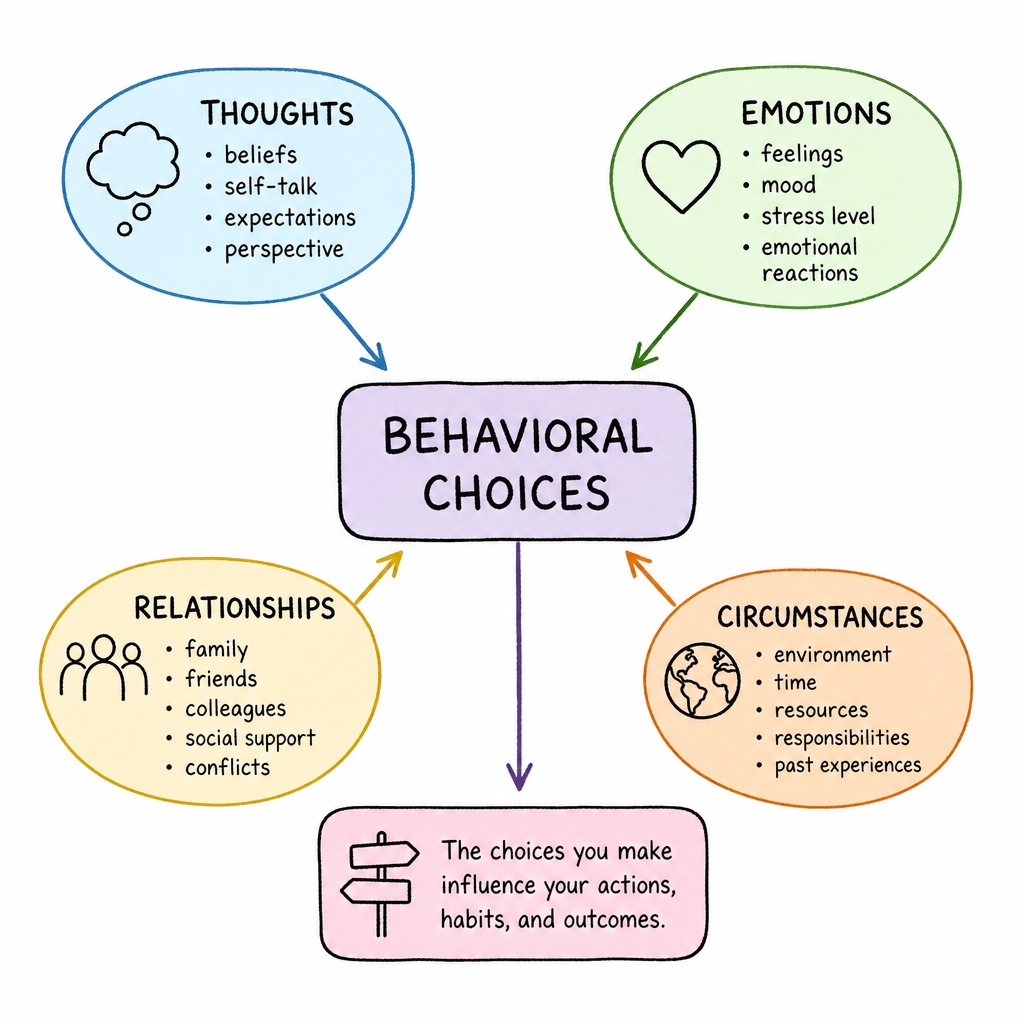
- Thinking patterns: Beliefs about entitlement, responsibility, other people, and acceptable behavior.
- Emotional regulation: Skills for managing anger, frustration, distress, and impulses.
- Social influences: Relationships that reinforce harmful behavior or support lawful alternatives.
- Development and circumstances: How age, experiences, and environments shape decisions.
- Protective factors: Strengths and supports that can reduce risk despite adversity. (nij.ojp.gov)
This subject overlaps with forensic psychology, but the terms are not interchangeable. Forensic psychology applies psychological knowledge to legal questions and settings, including assessment, treatment, testimony, and research. Studying why someone offends is one part of that broader intersection between psychology and law. (apa.org)
How Do Thoughts, Emotions, and Social Influences Interact?
These influences interact when a person interprets a situation, experiences an emotional response, and chooses an action within a social setting. A belief such as “disrespect must be punished” can make retaliation seem justified; peers may then encourage that response. Psychological analysis examines the links in this chain rather than treating the final act as self-explanatory. (nij.ojp.gov)
Thinking Patterns and Self-Justification
Some thinking patterns make harmful choices easier to defend. Examples include minimizing consequences, blaming the person harmed, claiming entitlement, or insisting that circumstances left no alternative. Cognitive-behavioral approaches address these patterns by helping people notice and challenge thoughts that support offending. (ojp.gov)
Consider a hypothetical employee who misuses company funds and says, “They underpay me, so this is fair.” Financial frustration describes a circumstance; the claim of entitlement supplies a justification. An explanation should examine both without presenting either as proof that theft was unavoidable.
Emotions and Behavioral Control
Difficulty managing anger, delaying gratification, or considering another person’s perspective can affect decisions. However, the useful question is not merely whether someone felt angry. It is how that person interpreted the feeling, which responses they considered, and whether they could interrupt an escalating reaction. These are among the skills addressed in cognitive-behavioral interventions. (nij.ojp.gov)
Relationships and Reinforcement
Peers and family environments also matter. Youth research identifies associations with delinquent peers, family conflict, and inconsistent discipline among relevant risk factors. Supportive adults and positive peer relationships can provide counterweights. Importantly, these are patterns of increased or decreased likelihood—not a formula that determines what any particular young person will do. (youth.gov)
Development and Adversity Shape Risk Without Determining Destiny
Development helps explain why the same situation may affect people differently at different ages. During adolescence, brain systems involved in planning and decision-making are still developing, while peer relationships become especially important. NIMH explains that social rewards can sometimes outweigh perceived consequences in teenage decisions. This does not mean adolescence itself is a sign of criminality. (nimh.nih.gov)
Adversity also deserves careful treatment. Exposure to abuse, family violence, unsafe environments, and disrupted relationships appears in research on youth delinquency and violence. Yet a risk factor is not necessarily a direct cause, and exposure does not establish a person’s future behavior. Analysis should consider protective relationships, resources, and individual strengths alongside difficulties. (ojjdp.ojp.gov)
For example, imagine two teenagers exposed to similar neighborhood violence. One has a trusted teacher and consistent access to supervised activities; the other lacks those supports. This hypothetical comparison illustrates why an assessment should ask about available protection, not simply count adverse experiences.
The practical lesson is to avoid turning someone’s history into an identity. “This person experienced serious adversity” is different from “this person was destined to offend.” Prevention focuses on what can change rather than treating past exposure as an irreversible prediction. (youth.gov)
Mental Illness Is Not a Synonym for Criminality
Mental illness should not serve as a catch-all explanation for disturbing behavior. SAMHSA states that most people with mental health conditions are no more likely to be violent than anyone else. Assuming dangerousness from a diagnosis replaces individual evidence with a stereotype. (samhsa.gov)
A psychological condition may be relevant to a particular assessment, but its significance must be evaluated rather than assumed. Forensic psychologists examine psychological characteristics in relation to specific legal questions. A diagnosis, an explanation of behavior, and a legal conclusion should therefore not be treated as interchangeable answers. (apa.org)
The same caution applies to labels encountered in crime coverage. Before accepting a label as an explanation, ask what evidence supports it, who made the assessment, and what question it actually answers. Describing someone as “disturbed” contributes little if it obscures documented decisions, relationships, or actions. The goal should be precision, not a dramatic description.
Investigative Evidence and Psychological Interpretation Have Different Roles
A crime scene investigator documents, locates, preserves, and collects evidence. That work helps establish the physical record from which an investigation proceeds. It is different from conducting a psychological evaluation, even though investigators and behavioral specialists may contribute to the same broader inquiry. (nist.gov)
Photographs are one component of documentation, alongside notes, sketches, collected material, and other records. FBI guidance describes photography within a larger evidence-collection process and explains how sketches complement two-dimensional images. Consequently, pictures from crime scenes should be considered within the full investigative record, not treated as a complete account by themselves. (leb.fbi.gov)
A photograph might document an object’s location. Saying that its placement proves a particular motive adds an interpretation that needs support. The distinction matters because an explanation can sound coherent while resting on an assumption that the available evidence does not establish.
A useful reading practice is to separate three statements: what was documented, what someone inferred, and what remains unknown. Forensic psychology itself is broader than the near-psychic profiling sometimes portrayed on television; the American Psychological Association explicitly cautions against that misconception. (apa.org)
True Crime Requires a Critical Reading Habit
When listening to a true crime podcast, assess the explanation as carefully as the storytelling. Does the presenter identify the source of a claim? Are interpretations labeled as interpretations? Does an expert explain the limits of their knowledge? Use those questions to keep an engaging narrative from becoming a substitute for evidence.
The same standard applies to searches such as “idaho 4 crime scene photos” or “ed gein crime scene photos.” Whatever prompts the search, approach the material with a clear question and an ethical boundary. Graphic detail should not become a shortcut to diagnosing someone or a reason to circulate images of victims.
Use this checklist when evaluating crime-related content:
- Trace the claim: Look for an identifiable document, attributable statement, or clearly described source.
- Separate fact from interpretation: Notice when a presenter moves from describing evidence to explaining motives.
- Check the scope: Ask whether a claim concerns one case, a research sample, or people generally.
- Look for uncertainty: Prefer explanations that acknowledge missing information and plausible alternatives.
- Respect people affected: Avoid sharing private details or distressing material simply to sustain discussion.
These are standards for responsible reading, not instructions to investigate strangers. You do not need to solve a case to learn from it. Often, the more useful exercise is identifying which questions the public record cannot answer.
Neighborhood Crime Scores Cannot Explain Individual Psychology
A search for a “best places crime score” concerns a different level of analysis: crime measures for a location rather than an assessment of a person. BestPlaces distinguishes reported crime rates from its own crime index. When using such information, check the geographic unit, data year, and measure before making comparisons. (bestplaces.com)
The FBI cautions that rankings can create misleading impressions when they ignore the variables shaping crime in different communities. A simple score should not be mistaken for a complete explanation of local conditions. (ucr.fbi.gov)
Most importantly, do not use an area-level number as a psychological description of its residents. “This place has a particular reported crime rate” and “this individual is likely to offend” are different claims. Moving from one to the other requires evidence that a neighborhood ranking does not provide. This distinction keeps community information from becoming a personal stereotype.
Can Understanding Criminal Behavior Help Prevent Reoffending?
Yes. Understanding changeable influences can help practitioners select interventions that address a person’s needs rather than relying on a generic explanation. Risk assessment can guide decisions, but it estimates likelihood; it cannot predict an individual’s behavior with certainty. Tools also vary in validity, making their suitability for the population important. (bja.ojp.gov)
Cognitive-behavioral approaches provide one practical application. They connect thoughts, feelings, and actions, helping participants recognize justifications for offending and practice different responses. A Bureau of Justice Assistance brief describes how these principles can be incorporated into correctional programming and supervision. The point is to build usable skills, not simply tell someone to “make better choices.” (ojp.gov)
Illustrative applications include:
- Conflict management: Rehearsing a response that interrupts escalation instead of treating retaliation as inevitable.
- Decision-making practice: Identifying a triggering situation, examining assumptions, and considering consequences before acting.
- Social support: Strengthening connections with people who support lawful goals rather than reinforce offending.
- Individual planning: Addressing changeable needs instead of treating historical risk factors as the whole story. (uscourts.gov)
Prevention also involves more than increasing punishment. NIJ’s deterrence summary emphasizes the importance of the perceived certainty of being caught compared with punishment severity. That distinction challenges the assumption that a harsher penalty automatically produces a stronger preventive effect. (nij.ojp.gov)
Public education is another, separate part of prevention. The character sometimes sought through “detective mcgruff crime dog” searches is officially McGruff the Crime Dog, whose campaign encourages crime-prevention learning. Such education should not be confused with individualized assessment or treatment. (ojp.gov)
Understanding Without Excusing Harm
Explaining behavior and holding someone accountable need not be competing aims. The strongest approach asks what evidence supports an explanation, what remains uncertain, and which changes could reduce future harm. It also keeps the people harmed visible rather than making the person who offended the only subject worth understanding.
Avoid the appeal of a single cause, a dramatic label, or an apparently revealing image. A more useful perspective is specific and measured: examine decisions in context, distinguish risk from destiny, and assess interpretations against evidence. Understanding should deepen responsibility and improve prevention—not turn speculation into certainty.